
Changing the finish in front of the client: why it closes faster
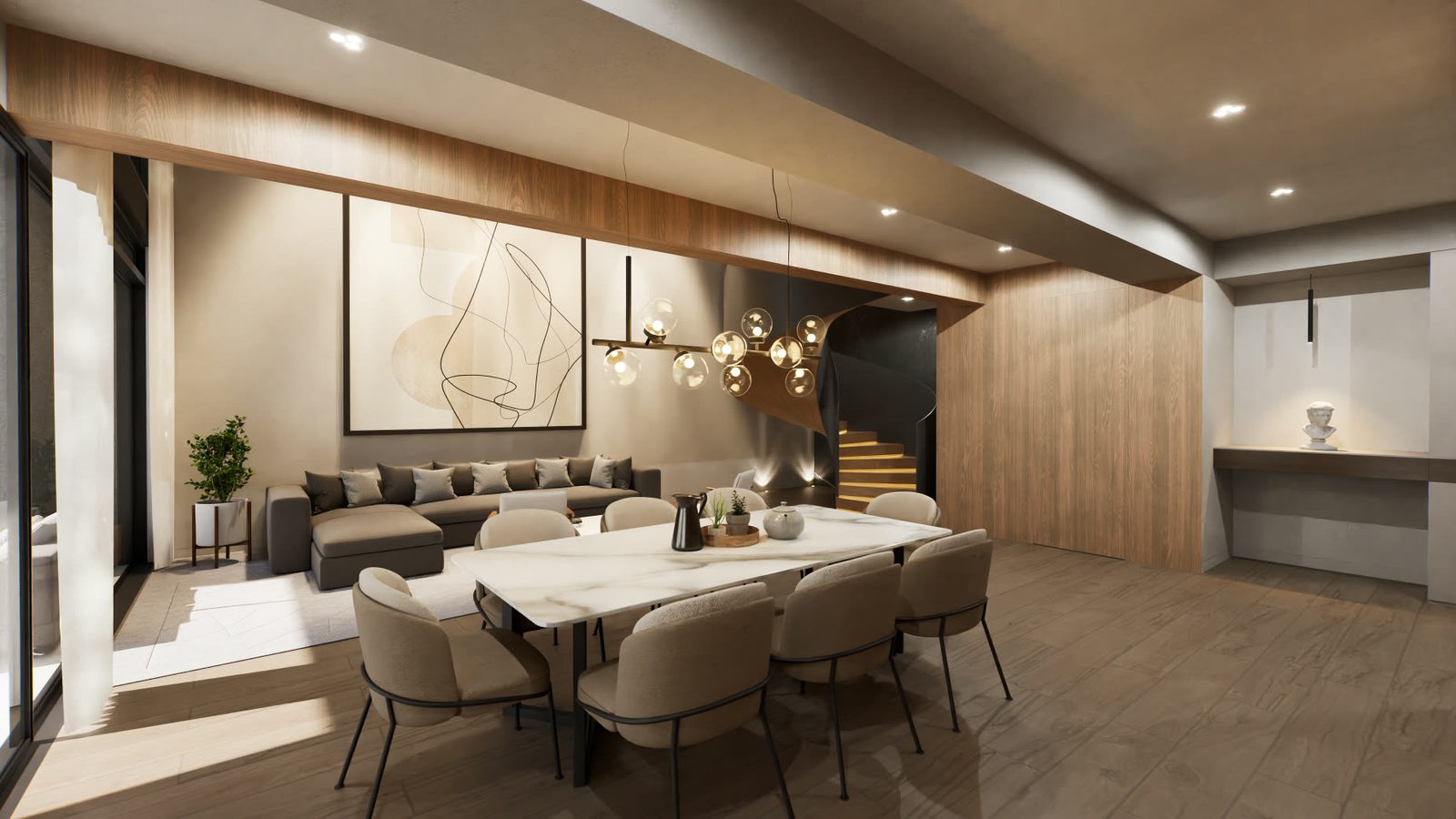
There's an awkward moment in every sales room: the rep describes a finish and the buyer nods without fully understanding. "Wood-effect porcelain, warm tone." Nobody knows what that looks like until they see it.
Want to see this on your project? Book a free demo
The friction is asking the client to imagine
That gap between what's described and what's understood is where off-plan sales are lost. Not because the product is bad, but because the decision gets postponed until there's more certainty, and meanwhile the buyer compares.
The traditional answer was the sample board: a frame with pieces of material. It helps, but it demands the same mental effort of projecting ten square centimeters onto a whole apartment.
Why live changes weren't possible before
In the classic rendering workflow, light was calculated and "baked" into the textures: a process that took hours per image. Changing a floor wasn't changing a color, it was redoing the calculation of how light bounces through the entire scene.
That's why finish options were delivered as a set of fixed images, decided months earlier. If the client asked for something else, the answer was "I'll send it next week."
What changed
Two advances in real-time 3D engines broke that limit:
- Dynamic global illumination. Lights, reflections and shadows recalculate themselves when something changes. You can run the time of day forward and watch the afternoon sun enter that living room, with no wait.
- Virtualized geometry. Models used to be drastically simplified to run smoothly, losing detail. Now the architectural model comes in essentially whole.
In practice, the rep changes the floor, the countertop and the furniture while the client watches, and the client sees the real effect of their decision.
The effect on the sales conversation
The deeper change has to do with the buyer's role, more than with visuals. They stop receiving a finished product and start configuring their own. That creates a commitment a catalogue never will: people defend what they helped build.
After deploying a platform with live personalization, DAMAC reported an increase of up to 400% in buyer engagement across all its channels.
The buyer stops looking at an apartment and starts assembling theirs.
Where it makes most sense
It performs best where there are real decisions to make: projects with several finish lines, bespoke corporate headquarters, high-value units. If the project offers a single finish with no options, live personalization adds little, and that's worth saying.
That's how we work it in the virtual sales room, on top of the project's digital twin.
Sources
Unreal Engine — PropVR’s digital twins help a developer boost revenue by 10x
Want to see this on your project?
Book a free demo and we'll show you a real virtual sales room, working.
Request a demo