
What a virtual sales room must contain (and what is unnecessary)
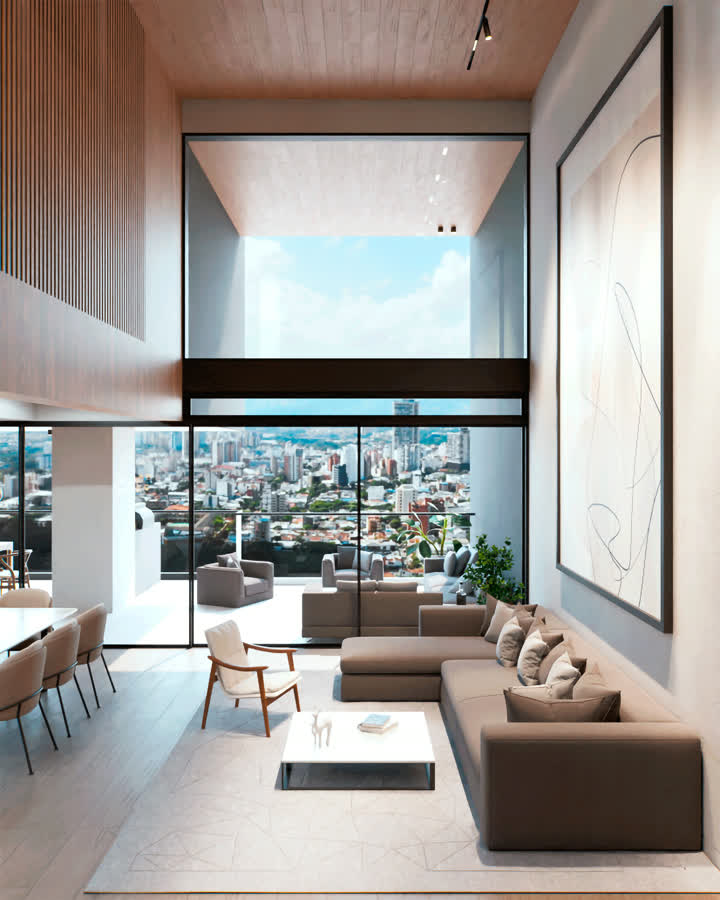
“Virtual sales room” is used today for very different things: from a thirty-second video to a full platform. If you are evaluating proposals, this is the list I would compare them against.
Want to see this on your project? Book a free demo
What cannot be missing
1. A first-person walkthrough of the unit type. The buyer decides where to look and at what pace, with no camera on rails. If they cannot turn around in the kitchen and look towards the living room, what you have is a video.
2. The real surroundings. The building does not float. If the project sells on the view, the model has to show that view from the floor the buyer is considering. And if there is an empty lot across the street where another tower is going up, say so.
3. The finishes you will deliver. Not attractive generic ones. The floor, countertop and fixtures from the specification. It is what avoids the most expensive conversation in the business, the one at handover.
4. Project information in the same place. Areas, unit types, availability, payment terms. If the buyer has to leave to find a PDF, you lost the moment.
5. A way to reach an agent without leaving. Book an appointment, open a WhatsApp, request a call. The walkthrough generates questions; if there is nowhere to ask them, they go unanswered.
6. It opens on a phone with nothing to install. This disqualifies more proposals than you would think. If an app has to be downloaded, half the people never arrive.
What is usually unnecessary
VR headsets. They impress at the trade show and are almost never used in day-to-day selling: they have to be kept, charged, sanitised and explained. They work for investors and presentations, not for the normal flow of a sales room.
Effects that get in the way. Long transitions, particles, music. Every second the buyer waits is a second they are not looking at your project.
What's worth adding later
Once the basics work, some features add a lot without making it harder to use:
- Light at different times of day. Seeing how the sun comes in during the morning and the afternoon answers a question the floor plan can't. We explain it in how to show the view and the light before building.
- A configurator with prices. Let buyers see how much the price changes when they pick another floor or another kitchen. There's more in the finishes configurator.
- Side-by-side unit comparison. Two apartments with their dimensions visible, so buyers can decide without going back and forth.
- A mode for the sales room screen. The same model on a touch screen for those who do visit.
- Another language. If you sell to foreigners, sales information in English keeps the conversation from depending on a translator.
One model, several formats
It is worth looking at how those doing this at scale solve it. PropVR, the firm behind DAMAC Properties’ digital twin, delivers the same model in six formats depending on the audience: touch screen for the sales gallery, pixel streaming with video call for the web, browser for remote reach, virtual reality for investors, LED walls for experience centres and holographic displays for events.
You do not need six formats. What is worth copying is that the format is chosen according to who you are showing, and that all of them come from the same model so they say the same thing.
How to compare proposals
When you have two or three quotes on the table, this table helps you see what each one includes and what to ask:
| What to check | What to ask | Red flag |
|---|---|---|
| The tour | Can I go anywhere and look in any direction? | A camera that follows a fixed path |
| Surroundings and view | Does the view come from the real location and height? | A generic landscape that's the same on every floor |
| Finishes | Do they come from the project specifications? | Attractive materials that won't be delivered |
| Sales information | Is availability kept up to date? | A separate PDF that goes stale |
| Contact | Can buyers write or book without leaving? | A hidden form |
| Mobile | Does it open over mobile data, with nothing to install? | A mandatory app |
| Data | Which reports does it provide, and how often? | No information on who uses it |
| Changes | What does it cost to change a finish or a unit type? | Every change is quoted as a new project |
How to know if it works
There is a simple test: if your agent is not using it in the first week, it does not work. A virtual sales room is an everyday working tool, not a marketing piece to approve and file away. If it is slow, if it needs explaining, or if it does not answer what the buyer asks, the agent goes back to the PDF.
And Zillow’s underlying figure still stands: 62% of buyers would like to see more 3D tours. The demand is there; what usually fails is the execution.
This is how we build each virtual sales room: tailored to the project and to the sales team that will use it, generated from the project’s digital twin.
What you need to get started
With the project drawings, finish specifications, unit types and sales information, the model can be built, even before construction starts. The time it takes depends on the size of the project and how well defined that information is: the closer it is to the construction set, the fewer adjustments later. We explain the full process in how to create a virtual sales room.
Frequently asked questions
What should a virtual sales room include?
A free walkthrough of the apartment, the real surroundings and view, the finishes that will actually be delivered, sales information in the same place, a way to talk to an advisor without leaving, and it has to open on a phone with nothing to install.
Do you need virtual reality headsets?
Not for day-to-day selling. They impress at trade fairs and investor presentations, but they have to be stocked, charged, cleaned and explained. A phone and the sales room screen cover most visits.
Does a virtual sales room have to work on a phone?
Yes. That's where buyers receive the link, usually on WhatsApp. If they have to download an app, many of them never get to see it.
How do you compare two virtual sales room proposals?
Check the same things in both: whether the tour is free, whether the view and finishes are real, whether sales information is kept up to date, whether it opens on a phone, what data it provides and what a change costs.
Sources
Unreal Engine — PropVR’s digital twins and DAMAC Properties · Zillow Research — Buyer preferences and 3D tours · Unreal Engine — How UE is transforming home building
Want to see this on your project?
Book a free demo and we'll show you a real virtual sales room, working.
Request a demo