
Pixel streaming: how a heavy 3D model fits on any phone
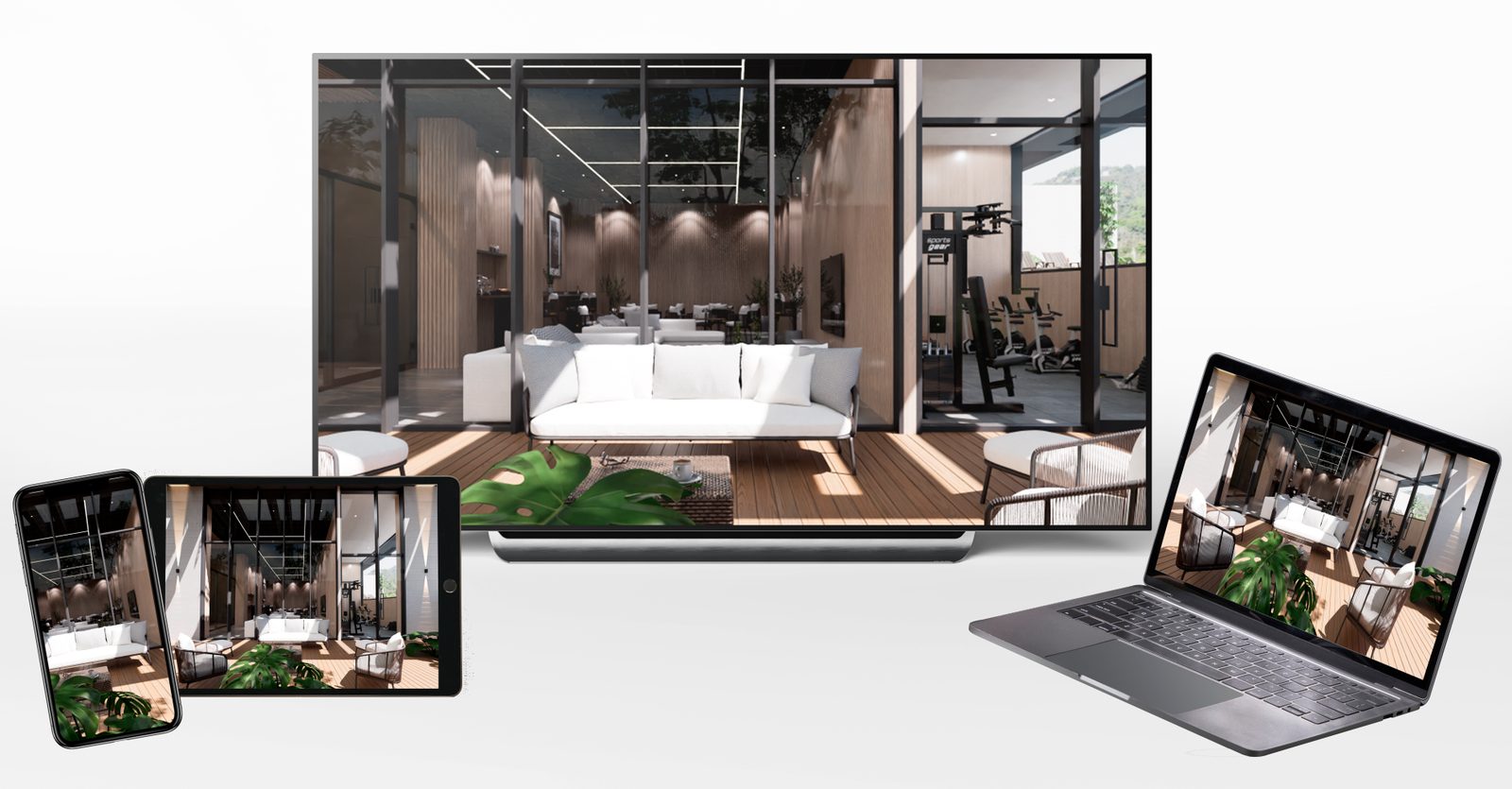
There's a technical limitation that held back remote real estate sales for years, and almost nobody named it: a good 3D model is heavy. So heavy the buyer's computer can't handle it.
Want to see this on your project? Book a free demo
The problem nobody wanted to admit
A detailed digital twin of a full tower (with its unit types, its finishes, its surroundings) can run to several gigabytes and demand a dedicated graphics card. For years that forced a choice between two bad options: simplify the model until it lost what made it convincing, or ask the client to install something.
Neither works when the buyer is nine thousand kilometers away and gave you fifteen minutes.
What pixel streaming is
The solution flips the problem. Instead of sending the model to the user, the model stays on a powerful server and what travels is video. The buyer watches a live stream of what that server is rendering, and their clicks travel back.
It works on the same logic as Netflix: nobody downloads the film. The result is that a mid-range phone opens a model its hardware could never process, from the browser, with nothing to install.
How it works, step by step
- The project model, built in Unreal Engine, runs on a cloud server with a powerful graphics card.
- The server renders the image in real time and encodes it as video, frame by frame.
- That video reaches the buyer's browser over WebRTC, the same technology behind video calls.
- Every tap, click or movement from the buyer travels back to the server, which answers with the new image in a fraction of a second.
For the buyer, it feels like moving through the project on their own phone. What they don't see is that all the heavy lifting happens somewhere else.
The case that put numbers on the table
DAMAC Properties, one of the large Middle East developers, sold off-plan megaprojects using expensive physical models and still renders. Their friction was attracting foreign capital: an investor in Asia or North America couldn't assess the product without traveling.
After deploying photorealistic digital twins with pixel streaming, according to the case published by Unreal Engine, they went from 24 million dollars to over 400 million in revenue attributed to the platform. Their buyer engagement metric rose by up to 400% across all sales channels.
The model didn't get better. It became reachable.
Why this matters in Colombia
It may sound like a Dubai problem, but it's exactly the Colombian market's bottleneck. Camacol measured that as of November 2025, 12.1% of the country's new housing was sold to non-residents, and that 68.1% of those purchases come from the United States.
That buyer is not going to install software to see your project. Either a link opens and works, or it doesn't exist.
Pixel streaming vs. other ways to show a 3D model
| What the buyer sees | What they need | Main limitation | |
|---|---|---|---|
| Downloadable app | The full model, in good quality | Installing a heavy file and a good computer | Almost nobody installs it |
| 3D in the browser (WebGL) | A simplified model | A browser and a reasonably capable device | Detail has to be cut so it loads |
| 360° tour | High-quality images from fixed points | Any browser | No free walking and no changing finishes |
| Pixel streaming | The full model, at top quality | A browser and a stable connection | Every session uses server time |
That's why they're usually combined: a 360° tour or short video for first contact, and pixel streaming for the virtual visit where the buyer decides.
What you're actually hiring
Here's the nuance that gets lost in proposals: the 3D model is half the job. The other half is the infrastructure that delivers it, where the server lives, how it scales when twenty people come in at once, what happens on a slow connection.
An excellent digital twin that only opens on the sales room computer is a half-built digital twin. You can see how we approach it in the digital twin and the virtual sales room.
What to ask a pixel streaming provider
- Where are the servers? The distance between server and buyer shows up as lag. If you sell in Colombia and the U.S., ask which regions it's served from.
- How many people can be in at once? Every active session uses GPU capacity. Ask how it scales during a launch and what users see when everything is busy.
- What happens on a slow connection? A good platform lowers the resolution before it drops the session.
- Does it work on iPhone and Android without installing anything? Try it yourself on an ordinary phone, over mobile data.
- How is it priced? By the hour, by session or as a monthly fee. Run the numbers against the traffic you expect.
- What data does it report? How many people came in, how long they stayed and which unit types they viewed. Your sales team needs that information.
The limits worth knowing
Pixel streaming depends on the connection. On a weak network the image loses sharpness, and if the server is far away you notice a slight delay when moving. It also has a usage cost, because every connected buyer takes up capacity on a GPU server. None of these limits rules it out, but they explain why the infrastructure has to be chosen carefully and combined with lighter assets for first contact.
Frequently asked questions
What is pixel streaming?
It's a way to show a heavy 3D model on any device. The model runs on a powerful server and the buyer receives live video in their browser, while their clicks and taps travel back to the server.
Does the buyer have to install anything?
No. They open a link in the browser on their phone or computer and the tour starts, with no software or apps to download.
What connection does the buyer need?
A stable connection, like home fiber or a phone with good 4G or 5G signal. On a weak network the image loses sharpness.
How is it different from a 360° tour?
A 360° tour shows images from fixed points and is very light. With pixel streaming the buyer walks freely through the project, changes finishes and looks out from any floor, with the quality of the full model.
Sources
Unreal Engine — PropVR’s digital twins help a developer boost revenue by 10x · Portafolio — Camacol / Coordenada Urbana: sales to non-residents
Want to see this on your project?
Book a free demo and we'll show you a real virtual sales room, working.
Request a demo