
Touchscreens in the sales room: how to make them the sales rep's best tool
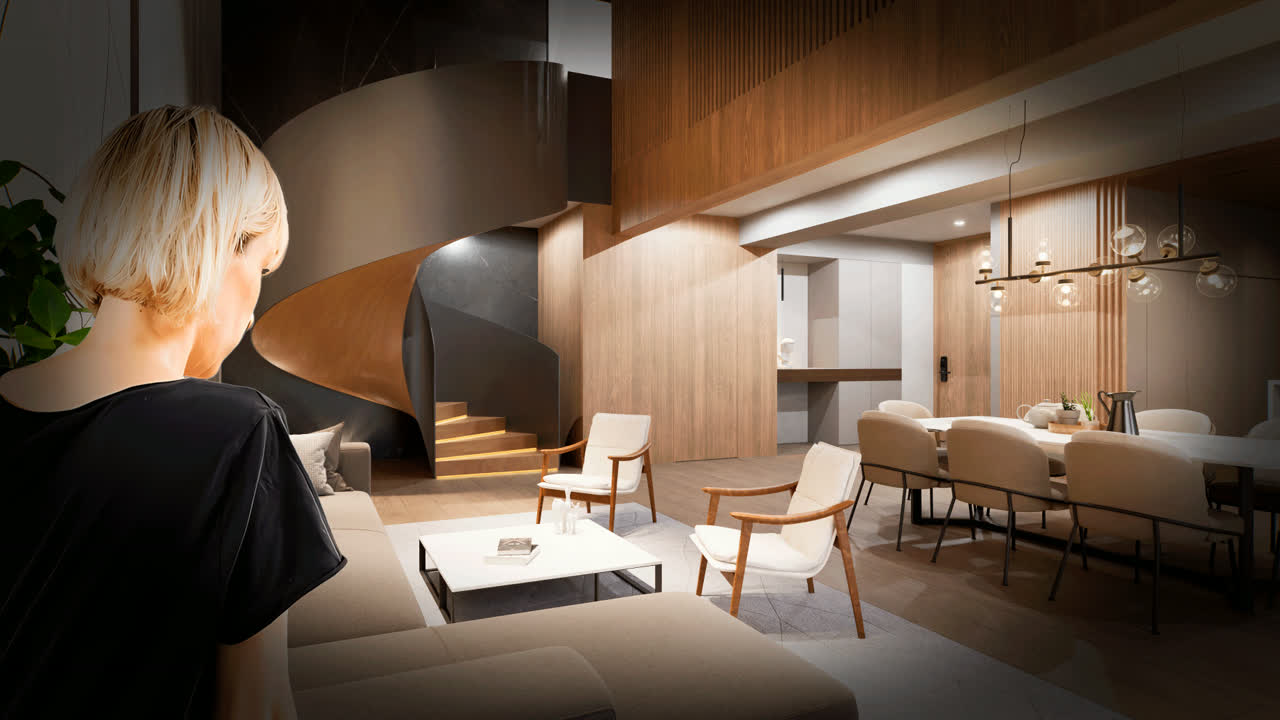
Walk into almost any sales room and you will find a big screen. Most of the time it loops the project video, with music, while the sales rep works at a table next to it with a printed floor plan. It is one of the most wasted investments in the sales process.
That same screen, touch-enabled and running the project model in real time, can be the most useful tool the sales rep has.
Want to see this on your project? Book a free demo
From a screen you watch to a screen you use
The difference lies in who controls what is shown, more than in size or resolution. A video is controlled by whoever edited it. An interactive screen is controlled by the buyer, who decides what they want to see. And as we explain in how to raise your sales room closing rate, whoever drives the tour starts taking ownership of the space.
What the buyer should be able to do
- Pick their unit from the overall view of the building, by floor and orientation.
- Walk through it at eye level, entering each room.
- See the real view from that unit's balcony.
- Change finishes: flooring, tiles, kitchen cabinets.
- Tour the amenities: pool, gym, terrace.
That is enough. The most frequent mistake is wanting the screen to do everything: menus with twenty options, technical sheets, endless galleries. The buyer gets lost and ends up asking the sales rep to drive.
What is behind it
The content is the project built in a graphics engine, Unreal Engine in our case, running in real time. Because the screen is large, image quality matters more than on a phone: every texture and every reflection shows. That is why in our tours we use NVIDIA's image upscaling and frame generation technology, which uses artificial intelligence to keep the image sharp and the motion smooth in large format.
On the practical side, the screen should run in kiosk mode, no desktop or windows in sight, return to the start on its own if nobody touches it, and have a visible button to start over.
The sales rep's role
The screen does not replace the sales rep; it changes their job. They stop explaining floor plans and start asking questions: "how many are in the family?", "do you work from home?", "which floor interests you?". With each answer, they take the buyer to the place in the model that answers it. According to the National Association of Realtors, 88% of buyers purchase through an agent: the tool is there to help them do it better, not to take them out of the process.
The screen and the phone, the same model
The underlying advantage is continuity. The sales room screen, the 360° tour sent over WhatsApp, the video call with someone far away and the portal renders all come from the same model. The buyer who touched the screen in the sales room opens the same apartment on their phone that night, with the same finishes. Nothing changes from one channel to another. If you are comparing this screen with a model apartment, see the real math.
Sources
NAR — Profile of Home Buyers and Sellers 2025 · NVIDIA Developer — DLSS · Unreal Engine — PropVR’s digital twins and DAMAC Properties
Ready to accelerate the sale of your project?
We build your project once in Unreal Engine, and the renders, video, 360° tours and interactive sales room all come from it, ready for any phone.
Request a demo