
Trade fair stand and travelling sales room: 20 m² that perform like a big room
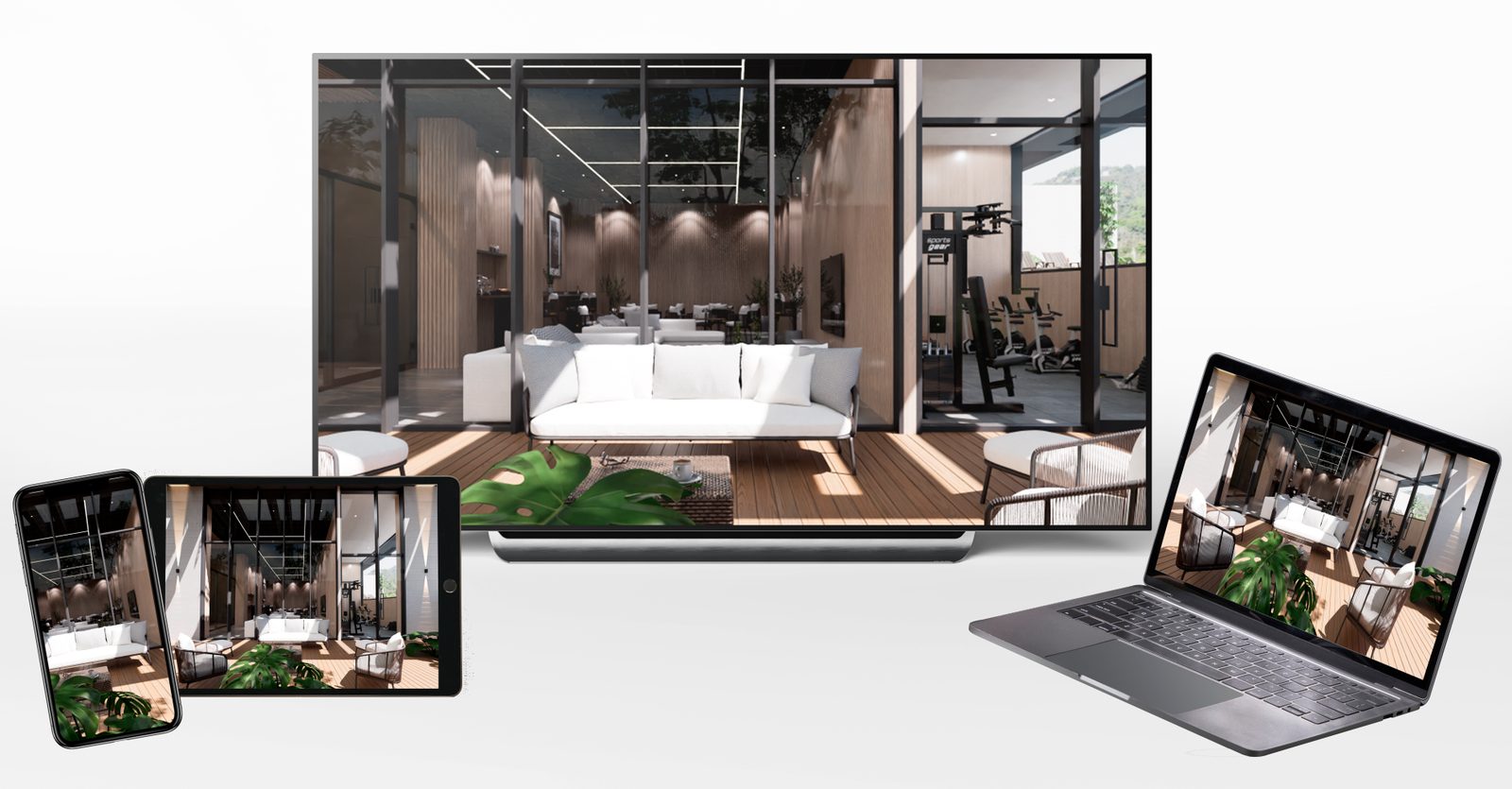
A real estate fair concentrates in three days the traffic a sales room sees in a month. The problem is that this traffic is in a hurry, glances sideways and compares twenty projects in one afternoon. With a banner and a brochure, it will most likely walk right past.
What changes the conversation in a small stand is being able to show the project from the inside, right there. And today that fits on a screen, not on a three-meter scale model that has to be transported and assembled.
Want to see this on your project? Book a free demo
Why fairs still work
Because anyone who goes to a real estate fair has already decided they want to buy; they just do not know from whom. It is qualified, concentrated traffic, and it is where buyers compare you head to head with the competition. If your project is the only one that can be shown from the inside, you win that comparison on the spot.
What fits in 20 m²
- A large screen with the 3D model. Portrait, at standing height, visible from the aisle. It is the stand's magnet and it replaces the physical scale model.
- A materials panel. Real floors, tiles and fixtures. It takes half a meter and gives the one thing the screen cannot.
- A small closing table. Two chairs, the price list and availability in view.
- A clearly visible QR code. So people who do not want to talk still leave with the tour on their phone.
- A loose tablet. So a second agent can work while the screen is busy.
What is almost always surplus: VR headsets. They impress and they consume the scarcest resource at a fair, which is the agent's time: you have to fit them, explain them, sanitize them and wait. While one person uses them, three walk away.
The thirty-second script
At a fair you do not start by explaining the project: you start by showing something that stops the person walking past. A tour moving on the screen, one short question, "buying to live in or to invest?", and, based on the answer, straight into the unit type that fits. From there to the view from their floor, and from there to a booked meeting. If in two minutes you have not booked, switch to the QR code and free the agent.
The technical things that ruin fairs
- The venue's wifi. It is never enough. Bring your own data plan and, if the tour runs over the internet, keep a version that runs locally on the machine.
- Brightness. Venues are bright; a dim screen cannot be seen.
- Sound. With noise all around, audio is useless: the model has to explain itself, with short on-screen text.
- Power. Ask for more outlets than you think you need and bring your own extension cord.
Capture the contact, not the brochure
The classic mistake is handing out leaflets and collecting business cards. Over three days, what matters is leaving with contacts you can classify: name, phone, unit type of interest and buying timeline, captured in the CRM on the spot. And with the tour already sent to the person's WhatsApp before they leave the stand: that is the material they will look at that night, when they compare.
The travelling sales room
The same setup works outside fairs. A travelling sales room is a stand that rotates: one weekend in a shopping mall, another in the next town, another in the city where your second-home buyer lives. Because the project lives in the 3D model, moving it costs nothing: what moves is the screen and the agent.
It is especially useful for reaching buyers who do not live where the project is, and for testing a city before deciding whether a permanent room is worth it there. If your buyers are abroad, the same material works at international fairs and over video calls; we cover it in how to sell to foreign buyers.
What to measure
Count four things per fair day: people who stopped, tours shown, contacts captured and meetings booked. Divide the stand's cost by the meetings and you get cost per meeting, which tells you whether to do it again. The rest of the dashboard is in sales room metrics.
For the interior setup, see designing the journey, and to see how this format fits with the rest, the real estate sales room guide.
Frequently asked questions
What do you need for a real estate fair stand?
A large screen with the project's 3D model, a panel with real materials, a closing table, a QR code to send the tour to people's phones, your own internet and a team with a short script to work in under two minutes.
Is it worth taking a physical scale model to a fair?
It takes a lot of space, it is expensive to transport and it only shows the exterior. A screen with the 3D model takes less room, shows the interior, the unit types and the view from each floor, and updates if the project changes.
What is a travelling sales room?
A small, transportable setup that rotates between shopping malls, towns or cities, with the project in the 3D model. It reaches buyers who do not live where the project is, without opening a permanent room.
How do you make the most of fair contacts?
By capturing them in the CRM on the spot, with unit type of interest and buying timeline, and sending the tour on WhatsApp before the person leaves the stand. Follow-up starts that same afternoon, not the following week.
Ready to accelerate the sale of your project?
We build your project once in Unreal Engine, and the renders, video, 360° tours and interactive sales room all come from it, ready for any phone.
Request a demo